
Piqua City Directory Shelves
The strongest documented Piqua city directory run is a local shelf, not a commercial database. Library of Congress Historic American Buildings Survey material records Piqua city and telephone directories from 1911 through 1986 in the Piqua Public Library special collections. The Local History and Genealogy Department keeps noncirculating Piqua and Miami County material, including family, house, business, event, and school files. Ask for a specific Piqua year and say whether the needed item is an alphabetical, telephone, or numerical street section. That request is more useful than asking staff to search every directory for a name.
A Piqua volume entry is a time-stamped clue. The canvass and publication dates can differ, and a missing name can mean that the person moved, was omitted, used initials, appeared in another section, or was not listed. The documented Piqua shelf proves the local run, but it does not prove that every individual year exists in the same form. Confirm the title page, the volume year, its section headings, and its repository citation before drawing a Piqua family conclusion.
| Collection | Documented span | Custodian | Access route |
|---|---|---|---|
| Piqua city and telephone directories | 1911-1986 | Piqua Public Library Local History | Appointment or in-person research; check the selected volume |
| Piqua Daily Call microfilm | Local holdings, exact run not posted | Piqua Public Library | Ask the department for obituary, address, or notice research |
| Historic Dayton Daily News | 1898-1922 | Piqua Public Library databases | Use the library's provided database access |
| Piqua and Lehman yearbooks | Many past volumes, dates not exhaustively posted | Piqua Public Library Local History | Local-history access |
| Maps, directories, census, and church microfilm | Collection-specific spans | Miami County Historical & Genealogical Society | Query or visit and confirm the exact item |
Piqua Historical Shelf Access
The Local History Department is at Piqua Public Library, 116 W. High Street. Its Piqua research hours are Monday through Thursday from 10 to 5, with an appointment required after 5, Friday from 10 to 1:30, and Saturday by appointment. Piqua materials do not circulate. Call 937-773-6753 ext. 231 or email localhistorydept@piqualibrary.org with a surname, likely year, and the kind of section needed. The department also keeps Piqua house files, yearbooks, newspaper resources, and migration material, which can help resolve a changed spelling or an address that does not appear where expected.
The library's genealogy and history database list identifies HeritageQuest, Fold3, African American Heritage, Newspaper Archive, Historic Dayton Daily News, and Ancestry Library Edition. Ancestry Library Edition is expressly an in-library resource. Use those Piqua research tools as companions to a volume, not as a replacement for seeing the local directory's title page and headings.
Piqua Public Library's genealogy database page shows the local online research menu.
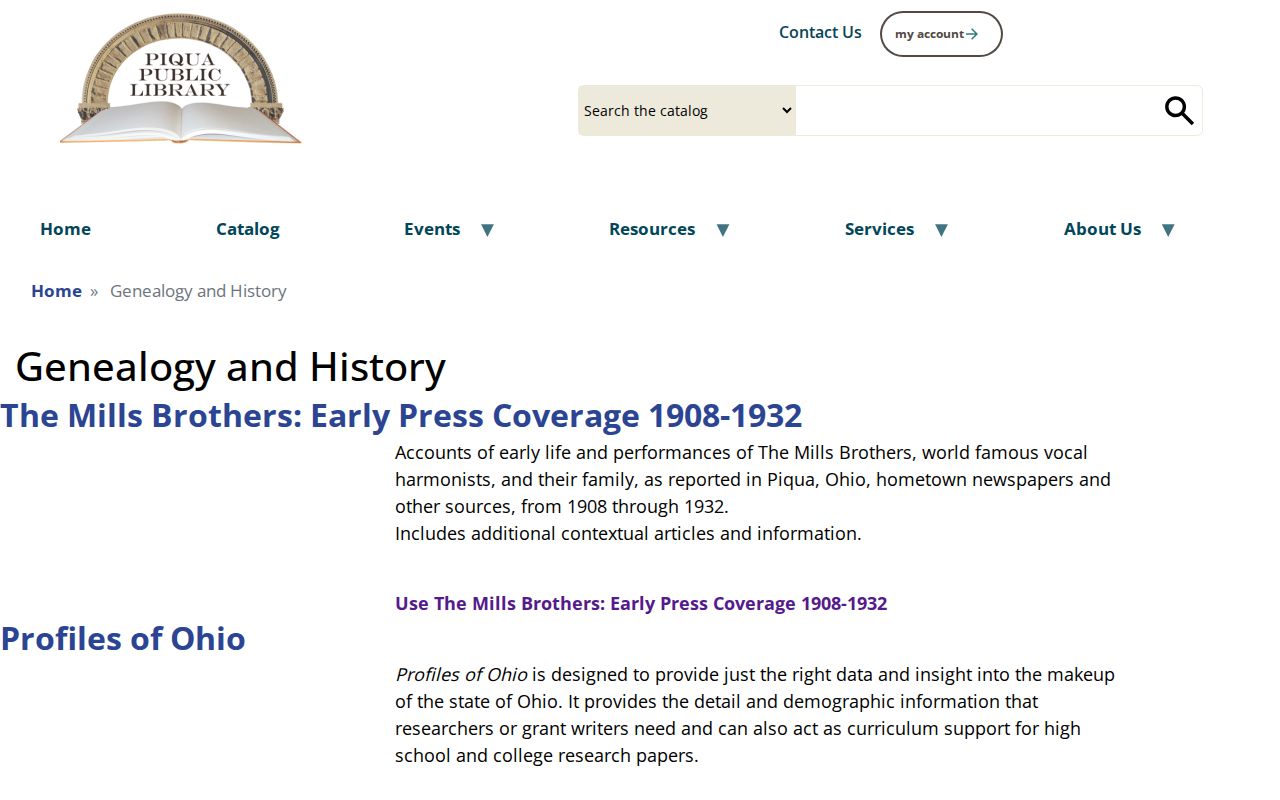
Library database access adds newspaper and family-history context to a selected entry, while the physical or microfilm volume remains the source for its exact wording and layout.
Note: A call or appointment is the documented fallback when a collection page does not expose the needed Piqua volume online.
Piqua Historical Companion Sources
Directories work best as one layer of a Piqua family record. The Piqua Daily Call microfilm, Historic Dayton Daily News for 1898-1922, and library yearbooks can supply a Piqua date, a school connection, a notice, or a name variant. A Piqua obituary is still only a lead. Confirm a date or family relationship with the appropriate custodian, such as Miami County Probate for a county marriage or estate record, rather than treating one newspaper notice as final proof.
The Miami County Historical & Genealogical Society, which partners with the Piqua library, describes 5,000 or more volumes, Piqua and Miami County maps from the 1850s, newspapers on microfilm from 1820, cemetery material, city directories, census, church, police, and court records. A narrow query, such as a family name plus a year and place, gives its volunteers a realistic way to identify an indexed book, vertical file, microfilm, manuscript, or map.
For a Piqua building or street question, the 1892 map and directory layers help establish context, while the modern parcel and deed sequence belongs in the Piqua Street Directory record trail.
Interpreting Piqua City Directory Entries
Read the heading, abbreviation key, and title page before extracting an entry. No digitized individual Piqua page was open during the research, so the field inventory below is a checklist for the selected local volume, not a transcription or a promise that every volume carries every field. A surname may be printed with initials. A spouse or widow notation, occupation or business line, residence address, business address, and telephone number may appear depending on the directory type.
| Name form | Record surname, given name or initials, and the spelling exactly as printed. |
|---|---|
| Family notation | Note any spouse or widow wording without assuming the relationship covers every person at the address. |
| Activity line | Copy an occupation or business listing as printed, then use it as a historical clue. |
| Address | Keep residence and business addresses distinct when a volume provides both. |
| Telephone or street position | Record either only when the selected telephone or numerical section displays it. |
- Criss-cross directory
- An address-ordered or numerical street section that groups listings by street number when that section exists in a volume.
- Householder index
- A name-oriented entry point used to locate a person or family before checking any street-oriented portion.
- Abbreviation key
- The volume's own explanation of shortened terms. Photograph or transcribe it before interpreting a mark.
Piqua Directory Manuscript Links
Piqua's archival layers overlap rather than form one seamless list. The library's MS-132 places Piqua City Council minutes on microfilm from April 1840 through November 1992. Its January 2026 manuscript listing identifies MS-281, Piqua Building and Zoning Permits for 1986-2004, along with church, school, reunion, newspaper, and genealogy material. These Piqua collections can explain a building change, a school connection, or a local event near a directory date. They do not create a complete list of people at an address.
The period anchors below are useful for selecting the next record type. They are not publication-change dates, and no official source located a citywide renumbering event or a loss of all Piqua records.
| April 1840-November 1992 | Piqua City Council minutes documented in MS-132 microfilm. |
|---|---|
| June 1892 | An 18-sheet Piqua Sanborn map is available through the Library of Congress. |
| 1911-1986 | Piqua city and telephone directories documented in the local special collections. |
| 1986-2004 | Piqua Building and Zoning Permits documented as MS-281. |
Note: Preserve the collection number, volume year, page or image, and whether an item is an index or original record.
Following a Piqua City Directory Household
A household trail needs a sequence, not a single hit. Start with the directory year nearest a known event, then track the exact spelling, initials, address, and any family notation forward and backward. Pair directory evidence with the federal census years through 1950, then use newspaper, probate, or recorded-land material to test a move, death, or relationship. The library's local files and in-library databases provide the Piqua-specific access channels for the historical layer.
- Request the selected Piqua year and identify whether it has an alphabetical, telephone, or numerical street section.
- Copy the title page, page number, full printed name, address, and any qualifying notation exactly as they appear.
- Check nearby years for a move, a spelling change, or the first and last appearance of the name.
- Pair the nearest directory dates with the 1910, 1920, 1930, 1940, or 1950 census as the chronology allows.
- Test a disappearance with an obituary, cemetery lead, Probate estate record, or Recorder document instead of assuming a reason.
Directory canvasses can predate the print year. A later volume can therefore preserve an address after a move, while a former volume can omit someone who arrived late in its canvass. Keep each source date beside the entry. If the question changes from a past household to a present-day named person, use the separate Piqua Resident Lookup verification path.
Piqua Directory Family Files
The Local History Department adds a human layer to Piqua directories. It maintains files on houses, families, local industries, events, migration origins and destinations, Piqua and Lehman school material, military history, and local newspapers. The 2026 manuscript inventory also names the Charles C. Simmons Genealogy Document Collection, First Baptist-related records, class photo and reunion materials, and veterans collections. A directory can establish where a name appeared; these materials may help explain why that name is meaningful to a family history.
Repository rules still matter. A school or organization item can document a historical appearance or connection without supplying current contact details or a complete membership list. Ask staff for the collection title and citation, and handle restricted or unpublished material under the repository's terms.
Piqua Directory Dates and Gaps
Do not turn the 1911-1986 directory shelf into a claim of uninterrupted city coverage. Earlier Piqua research can begin with Miami County deeds, Probate material, tax maps, cemetery and church records, and census records. The 1892 Piqua Sanborn map supplies an 18-sheet physical view of streets and structures, not names of occupants. Later questions may require a library appointment, a City of Piqua public-record request, or a Miami County custodian in Troy.
The practical rule is simple: use a directory to locate a historical lead, preserve what its own Piqua volume says, and compare it with an independent Piqua source. That approach respects the useful limits of the volumes while keeping a Piqua family trail grounded in the actual record keeper.