
Piqua Resident Record Coverage
Every Piqua resident lookup starts with a simple rule: separate sources answer separate questions. Miami County property records tie a Piqua name to recorded land. Ohio voter rolls confirm registered-elector facts. Piqua court and Probate files document a case role or an estate relationship. No single source is a master list of everyone at a Piqua address. Begin with the record that fits the fact you already hold. Then chase a second independent match: a middle initial, an event date, a parcel description, a court division, or a family record.
Piqua sits in Miami County, so the main Piqua county custodians work out of Troy. The Auditor, Recorder, Clerk, Probate Court, tax maps, and Board of Elections are county operations. City-held permits, police records, GIS material, and the Local History Department run through Piqua's own channels. Knowing that split saves trips. A deed or estate question sent to the wrong office just comes back. It returns with a referral.
| Record | What it can confirm | Piqua-area custodian or search | Access boundary |
|---|---|---|---|
| Piqua parcel card | Recorded owner, parcel context, situs, and tax-contact fields | Miami County Auditor | Owner and mailing fields do not list every Piqua resident. |
| Piqua recorded instrument | Party to a land transaction and legal description | Miami County Recorder | Name-first search; free images are watermarked. |
| Piqua voter record | Public registered-elector fields and precinct where available | Ohio My Voter Information | Redactions and confidential registrations apply. |
| Piqua court docket or file | Public case party, type, dates, and filings | Miami County courts | Sealed, juvenile, adoption, and other confidential material stays closed. |
| Piqua Probate estate | Decedent, fiduciary, heirs or beneficiaries in a public estate record | Miami County Probate CaseLook | Posting can lag and must be verified with the court. |
| Piqua vital record | A birth, death, marriage, or divorce event | Probate, Public Health, Clerk, or state archive by year | Custody and restricted categories vary by record type. |
| Piqua professional credential | Named license and status | Ohio eLicense | Credential status is not address proof. |
Starting a Piqua Name Lookup
When you hold a Piqua address or a likely owner, start with the Auditor's combined "Search by Parcel, Owner or Address" field. County guidance favors last name first for an owner search. For a Piqua address search, the house number alone often works best. A hit can return the parcel, situs address, municipality, school district, deeded-owner address, and taxpayer address. It can also return the legal description, sales, values, exemptions, and tax tabs. Those fields build property and tax context for a Piqua name, not a full household.
Keep the Auditor's three address ideas distinct. The situs is where the Piqua parcel physically sits. Deeded-owner and taxpayer addresses are tax-contact fields. Either can differ from the situs and from each other. A property hit grows stronger when the same name appears in a Recorder instrument. That instrument may carry the same legal description or another shared identifier. The Recorder advises name searching. Some instruments carry no address or parcel number at all.
For one-person verification, write down the exact name form, middle initial, and address field type. Also note the source date and the parcel or document number before you open the next record. A shared surname on a Piqua street is never enough to join two files.
Piqua Court Record Checks
A Piqua court name check begins with the Miami County Public Access route. It also needs the right division. Municipal Court covers Piqua-area traffic, misdemeanors, and small claims. Common Pleas covers Piqua-area civil, felony, domestic-relations, appeals, liens, and related clerk filings. Probate covers estates, guardianships, name changes, adoptions, civil commitments, and marriage licenses. The Public Access screen publishes no reliable set of filter labels. Do not assume exact-match or date filters exist. The practical fallback is a focused clerk request or a counter visit carrying the party name, an approximate year, the division, and a case number if you have one. The Miami County Clerk of Courts lists the local access points. Those points confirm a public Piqua-area trial-court record.
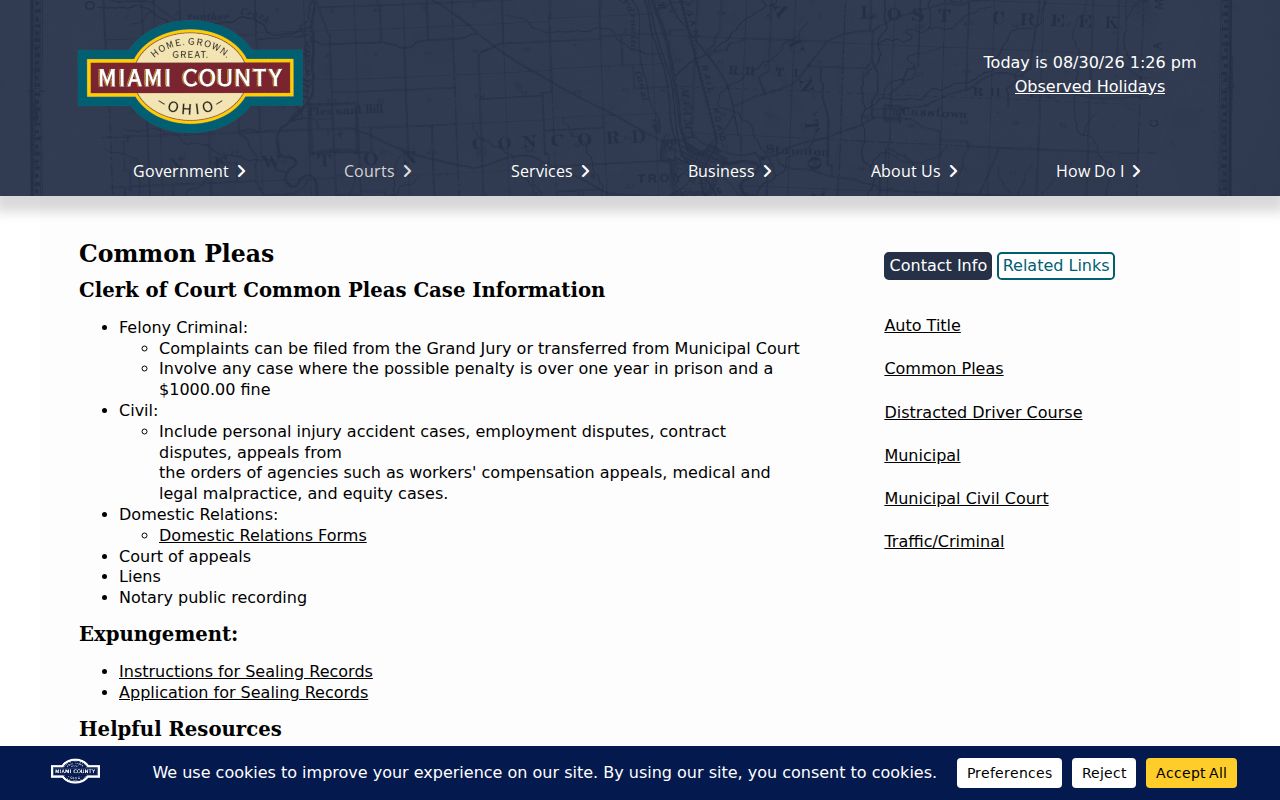
The local clerk remains the right channel for Piqua-area Miami County trial-court material. An appellate search has different coverage. It cannot substitute. The Supreme Court of Ohio public docket serves only its own state high-court matters. Those are filed from 1985 onward, plus practice-of-law cases from 1989. Its fields include case-number year and number, plus case caption. Advanced, party, and attorney searches are expandable. Results can show case number, caption, filing date, status, type, and prior jurisdiction.
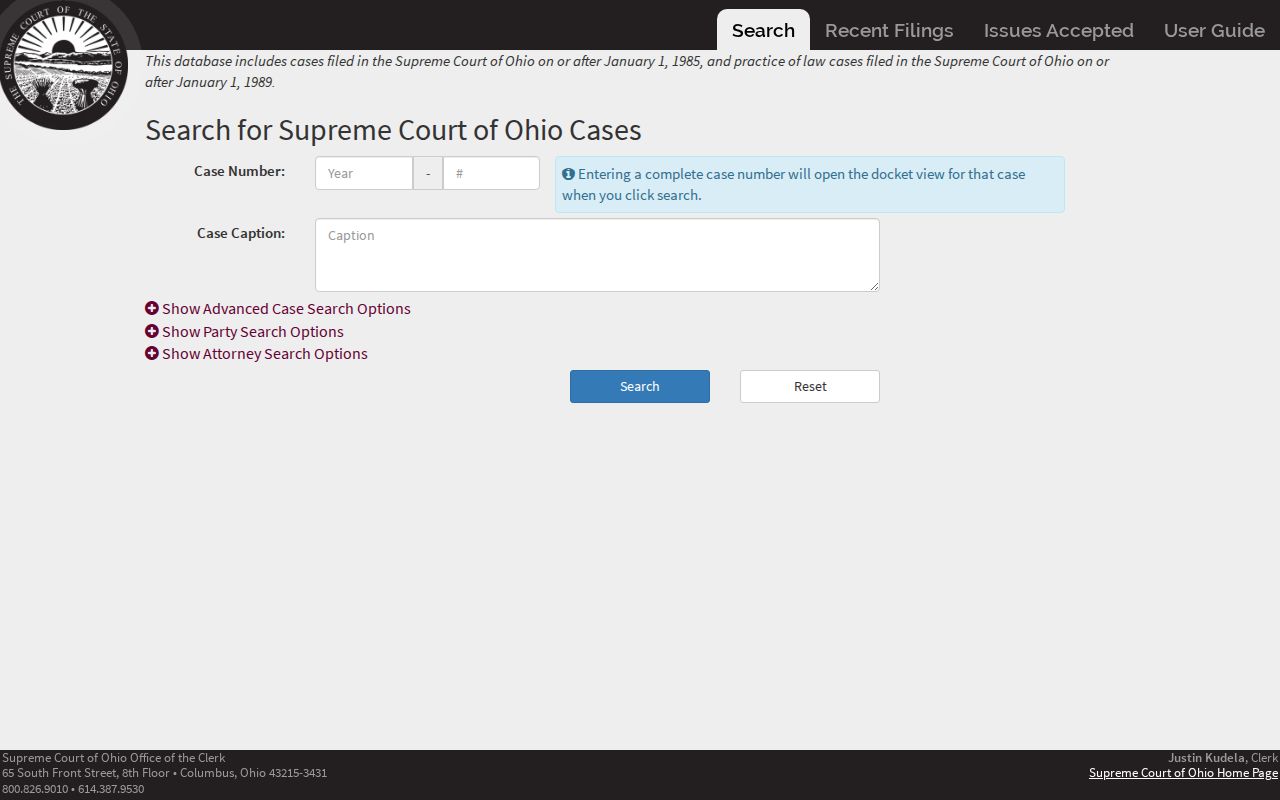
Treat a state docket result as a lead with a court-specific scope. Match its party name and prior jurisdiction before tying it to any Piqua person or Piqua case.
Piqua Vital Record Custody
Vital records in a Piqua resident lookup split by event and year. Miami County Probate reports marriage records from 1807 forward, births from 1853 through 1908. Deaths run from 1867 through 1908. Later birth and death requests go to Miami County Public Health. Divorce lives with the Clerk of Courts in the filing court. Ohio History Connection helps with historical material, including 1908-1970 death research. Its own guidance warns that indexes can carry transcription gaps or missing state submissions.
Ohio Revised Code 3705.23 directs the registrar to issue an ordinary certified vital copy on a signed application and fee. That holds unless a closure applies. Adoption-origin records and the medical portion of a birth record remain important limits. A marriage application is not proof a marriage was completed. When the event itself matters, confirm the issued or certified record with Probate. The Miami County Probate's marriage application gives the local online starting point for that request.
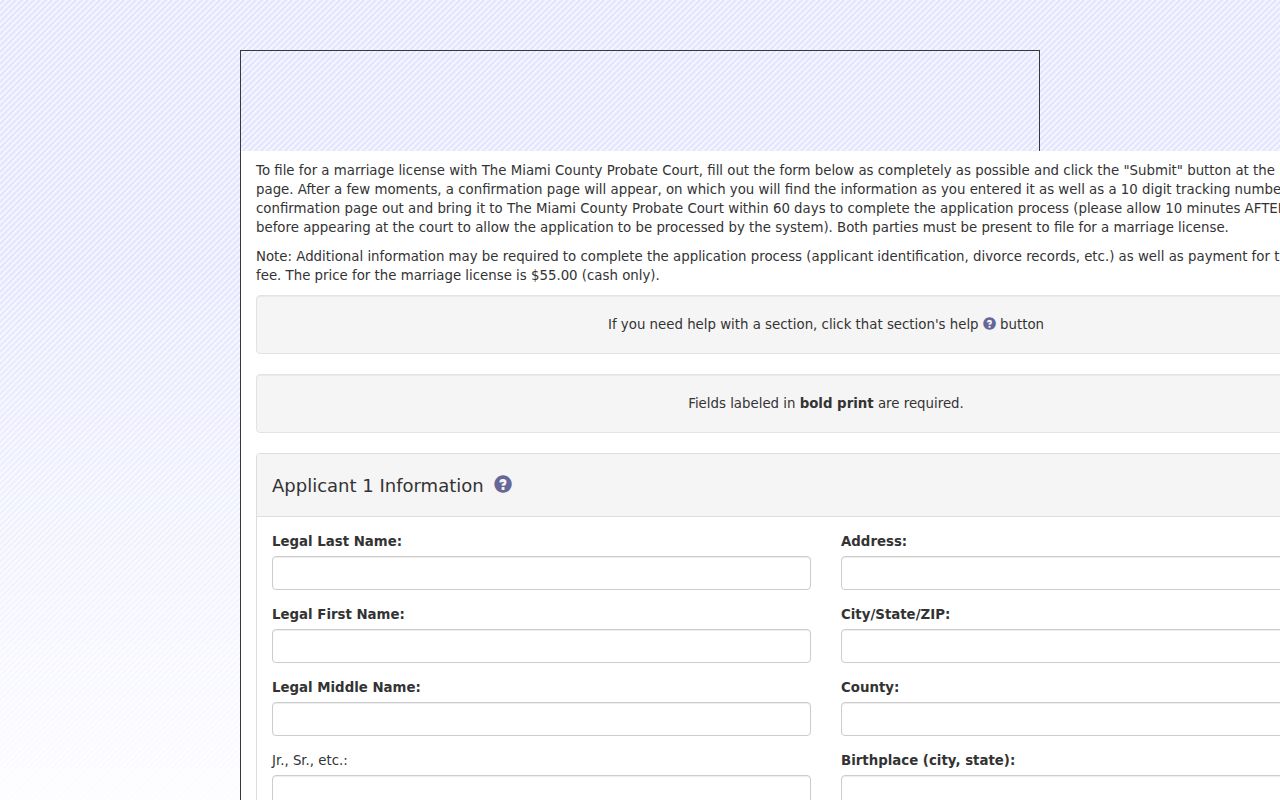
An approved Piqua marriage application is only a first step. Both applicants must still appear at Probate inside the stated 60-day window. Until then, treat the application screen as unfinished business rather than a completed marriage record. For vital copies, Miami County Public Health's certified-copy form lays out the local request fields for birth, death, and fetal-death certificates. It also lists the accepted payment channels.
The fee is spelled out plainly. A local copy costs $24, whether it is a birth, death, or fetal-death record used in Piqua research. Requests can move by mail, fax, or email, though the certificate itself never doubles as standalone identity proof.
Piqua Record Result Fields
Gather enough detail to retest any Piqua match. The Auditor parcel card opens with a combined search entry. It then splits into identity and location fields. Parcel number, owner, address, municipality, township, and school district all appear there. Deeded-owner and taxpayer addresses sit alongside the legal description. Tax classification, values, exemptions, sales, land, improvements, and tax data appear there too. Keep this in mind. The county frames the Piqua card as property and tax evidence. It is not a public household roster for a residents directory.
| Name form | Exact spelling, initials, former surname when supported, and role in that record. |
|---|---|
| Source identifier | Piqua parcel number, document number, book and page, case number, or record request reference. |
| Date detail | Piqua recording, filing, event, or source-processing date, with the type of date noted. |
| Location detail | Situs, mailing, legal description, court division, precinct, or other field exactly as labeled. |
| Access status | Index, watermarked image, requested copy, or certified copy, so a lead is not confused with verification. |
Context travels with every copied field. Note: A field copied without its portal, record number, and date becomes hard to verify later and can attach to the wrong person in a Piqua resident lookup.
Verifying a Piqua Resident Lookup
Verification in Piqua is a cross-check, not a single lookup. Start with one official record that ties a name to the city. Then bring in a second Piqua source. It should record a different fact about the same person. The Ohio voter form asks for first name, last name, and county. Official tips recommend trying a derivative first name. A former last name or an earlier Ohio address can also help where those apply. Statutory redactions and confidential registrations shield parts of the public fields. So a Piqua result, or even a blank one, is never the full story. It cannot deliver a complete household picture from the street directory angle.
- Write the name exactly as found and retain the source identifier, date, and role.
- Check the Auditor or Recorder only when a property or instrument link is plausible, keeping situs and tax-contact fields distinct.
- Use the Ohio voter lookup with required name fields and Miami County, then compare only public result details.
- Check the proper Miami court or Probate channel for a public case, estate, or marriage connection, noting its division and date.
- Request a custodian copy when the decision depends on a verified document rather than an index screen.
- Docket
- A court's chronological case record, which may list parties, filings, orders, and dates without proving identity on its own.
- Index and image
- An index points to a record. An image is a view of the underlying document, and its availability can differ by office.
- Certified copy
- A copy issued by the record custodian with certification. It is different from a search result or an unofficial image.
Piqua Family Record Evidence
For an old classmate, the department often helps. For a family-history puzzle or an heir trail, the Piqua Public Library's Local History and Genealogy Department often reaches deeper than a statewide index. Its shelves hold Piqua and Lehman yearbooks. House and family files sit nearby. Local industry and event material, migration information, military history, newspapers, and manuscripts round out the collection. The January 2026 listing adds class photo, reunion, church, veterans, and genealogy collections. Ask by school, year, name, and any known prior name. Do not ask for private contact information.
The Local History Department and its genealogy databases are the access route. An obituary or a yearbook can anchor a person to a time and place. Probate records or a death record can then test the relationship. Cemetery material or a recorded instrument can too. For historical directories as a research path, the Piqua Directory Book covers them in depth.
Piqua Resident Lookup Privacy Limits
Ohio's Public Records Act, ORC 149.43, opens many public-office records but carves out exemptions. Voter statutes protect Social Security numbers, driver and state-ID numbers, phone numbers, email addresses, and confidential registrations. They also shelter qualifying address redactions for designated public-service workers. Ohio Safe at Home gives qualifying survivors a substitute address. A confidential voter registration is stripped from public versions of voter databases and lists. So an apparent gap never proves that a person has no record. It does not erase a Piqua connection either.
When a Piqua record is wrong, contact the office that keeps it. The Auditor, Recorder, Board of Elections, courts, and registrar each run their own correction procedures. ORC 149.45 adds a specific online-redaction process for certain personal information and qualifying public-service-worker addresses. It carries one notable county Auditor exception. Anyone with an address-safety concern in Piqua should turn to the Ohio Safe at Home program or a trusted advocate. Sensitive address details should not go into an ordinary request.
Lawful personal use. Use Piqua resident lookup records for legitimate personal, family-history, estate, civic, or safety research. Ohio law prohibits stalking, harassment, threats, and intimidation, even when a source is public.
Piqua Record Request Fallbacks
When a Piqua search screen dead-ends, go straight to the custodian with a narrow request. Ohio's Public Records Act demands no special form. An office may still offer one, and using it can speed things along. Name the Piqua record series and the person. Give the date range too. Add the address, parcel, or case number. Say whether inspection or a copy is what you need. The city keeps separate police, crash, and non-police request paths. Miami County Municipal Court designates its administrator as custodian. This covers records the County Clerk does not hold. The court also supplies its own public-records form. Miami County Municipal Court's public-records-request information documents that court-specific fallback. Use it for anything a search result does not surface.
A request lands best when it names the right court division or record series. An approximate date helps the custodian find the file fast. No request can open sealed material. Confidential records stay closed, however precise the request is. Note: One defined record series per request is clearer and more likely to reach the correct Piqua or Miami County custodian.